

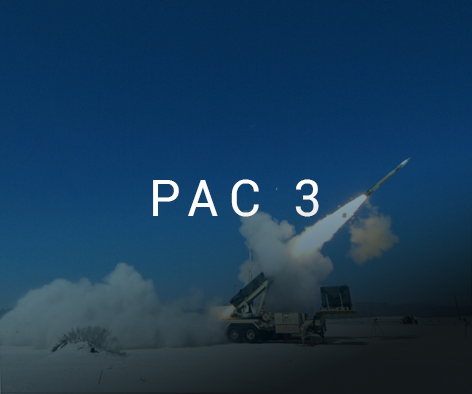
PAC 3 PROGRAM SUMMARY
The PAC-3 (Patriot Advanced Capability) is another upgrade of the Patriot Air Defense Missile System. The PAC-3 upgrade carried with it a new missile design, nominally known as MIM-104F and called PAC-3 by the Army. It evolved from the Strategic Defense Initiative’s ERINT missile, and so it is dedicated almost entirely to the anti-ballistic missile mission. Patriot’s PAC-3 interceptor is the primary interceptor for the new MEADS system, which was scheduled to enter service alongside Patriot in 2014. In addition to the United States – Germany, Japan, The Netherlands, Taiwan, and the United Arab Emirates have included the PAC-3 missile in their air and missile defense systems. The Patriot Missile System is in service (or on order) with 13 nations worldwide.
GENERAL DATES
DATES WITH PIONEER
- 2001: Operational testing of the PAC-3 missile began
- 2003: Initial Operational Capability (IOC) was achieved
- 2010: Lockheed Martin delivered the 1000th PAC-3 missile to the Army
- 2012: The AEGIS BMD Combat System, the PAC-3 missile, and THAAD (incl. two AN/TPY-2 radars) engaged in the first-ever test of all three systems working together to detect, track, engage, and eliminate two ballistic missile targets (out of three) and one cruise missile target (out of two).
- 2014: Qatar ordered 10 missile systems in a $2.4 billion Foreign Military Sales (FMS) deal.
- 2015: It was reported that Poland plans to buy eight Patriot missile batteries by 2025 and will enter exclusive talks with the U.S. Government.
- 2015: Lockheed Martin was awarded a $1.5 billion contract for production and delivery of PAC-3 MSE missiles for the U.S. Army and Foreign Military Sales (FMS) of PAC-3 interceptors, associated equipment and spares for South Korea, Saudi Arabia, Qatar, Taiwan and the United Arab Emirates.
- 2015: Lockheed Martin was awarded a $1.1 billion contract for PAC-3 MSE interceptors for the U.S. Army and Foreign Military Sales (FMS) of PAC-3 interceptors, launcher modification kits, associated equipment and spares for Saudi Arabia, South Korea, and Qatar.
- 2003: First PAC 3 Booking placed by 105-Boeing Company Huntsville
- 2003: First PAC 3 Shipment
- 2004: 411-Chemring Energetic Devices places their first PAC 3 booking
- 2004: 544-LMCO Missile & Fire Control places their first PAC 3 booking
- 2006: 707-Lockheed Martin M&FC – MA places their first PAC 3 booking
CUSTOMERS ON PROGRAM
SUPPLIERS
- 105-Boeing Company Huntsville
- 411-Chemring Energetic Devices
- 544-LMCO Missile & Fire Control
- 707-Lockheed Martin M&FC
- Lockheed Martin [LMT] is the prime contractor for the PAC-3 missile.
- Lockheed Martin is producing the combat-proven PAC-3 Missile for the U.S. Army Missiles and Space Program Executive Office
- The original Patriot was built by Raytheon [RTN], which continues to be responsible for the system integration.
- Suppliers: Honeywell, Goodrich and Paker Aerospace, ATK Composites, Vought Aircraft Industries, Smiths Aerospace, Moog Inc, EDO Corporation, Stork Aerospace, Aerojet
- Boeing – Partner to PAC 3 Program
ANNUAL REVENUE HISTORY
| Year | Extended Price |
| 2003 | $7,000 |
| 2004 | $72,302 |
| 2005 | $254,468 |
| 2006 | $816,467 |
| 2007 | $1,855,418 |
| 2008 | $7,645,795 |
| 2009 | $5,879,331 |
| 2010 | $5,987,990 |
| 2011 | $6,029,900 |
| 2012 | $3,182,646 |
| 2013 | $3,228,065 |
| 2014 | $3,980,422 |
| 2015 | $4,872,077 |
| 2016 | $3,216,333 |
| 2017 | $1,498 |
CURRENT & FUTURE NEWS
- The PAC-3 missile is currently being upgraded through the Missile Segment Enhancement (MSE).
- Lockheed Martin has proposed an air-launched variant of the PAC-3 missile for use on the F-15C Eagle. Other aircraft, such as the F-22 Raptor and the P-8A Poseidon, have also been proposed.
- One hundred percent effective in Operation Iraqi Freedom, PAC-3 Missiles are now deployed with U.S. forces.
- Patriot upgrades continue, with the most recent being new software known as PDB-7.x (Post Deployment Build). This software will allow Configuration 3 units to discriminate targets of all types, to include anti-radiation missile carriers, helicopters, unmanned aerial vehicles, and cruise missiles.